Breast cancer occurs when there is an uncontrolled growth and abnormal mutation of cells in the breast, leading to the formation of tumors.
These cancerous cells have the potential to invade nearby tissues in the breast and, in some cases, can spread to other parts of the body, forming new tumors. This process is known as metastasis.
Epidemiology of Breast cancer
Female breast cancer has now surpassed lung cancer as the most commonly diagnosed cancer worldwide.
The disease is the fifth-leading cause of cancer mortality worldwide, with 685,000 deaths in 2020.
The estimated 2.3 million new cases indicates that, 1 in every 8 cancers diagnosed in 2020 is breast cancer.
Risk Factors of Breast Cancer
Risk for breast cancer is due to a combination of factors. The main factors that influence our risk include being an older woman.
Risk Factors You Can Change (Modifiable)
1.Physical Inactivity: Women who are not physically active are at a higher risk of developing breast cancer.
2.Overweight or Obesity after Menopause: Older women who are overweight or obese face a greater risk of breast cancer compared to those maintaining a healthy weight.
3.Hormone Use: Certain hormone replacement therapies, particularly those containing both estrogen and progesterone, when taken for more than five years during menopause, can increase the risk of breast cancer. Additionally, some oral contraceptives have been associated with elevated breast cancer risk.
4.Reproductive History: Delaying the first pregnancy until after age 30, not breastfeeding, and never having a full-term pregnancy can elevate the risk of breast cancer.
5.Alcohol Consumption: The risk of breast cancer tends to increase with higher alcohol consumption among women.
6.Other Factors: Smoking, exposure to cancer-causing chemicals, and disruptions in hormone levels due to night shift work are among additional factors that may contribute to an increased risk of breast cancer according to research.
Risk Factors You Cannot Change (Unmodifiable)
1.Genetic Mutations: Inherited mutations in genes such as BRCA1 and BRCA2 increase the risk of both breast and ovarian cancer.
2.Reproductive History: Early onset of menstruation (before age 12) and late onset of menopause (after age 55) expose women to hormones for longer periods, thereby increasing the risk of breast cancer.
3.Dense Breasts: Women with dense breasts, which have more connective tissue than fatty tissue, may have difficulty detecting tumors on mammograms, increasing their risk of breast cancer.
4.Previous Breast Conditions: Prior breast cancer or atypical ductal hyperplasia can increase the risk of developing breast cancer.
5.Family History: Having a first-degree relative (mother, sister, daughter) with breast or ovarian cancer, or multiple family members with these cancers, increases a woman’s risk. A first-degree male relative with breast cancer also raises the risk.
6.Radiation Exposure: Radiotherapy to the chest at a young age elevates the risk of breast cancer.
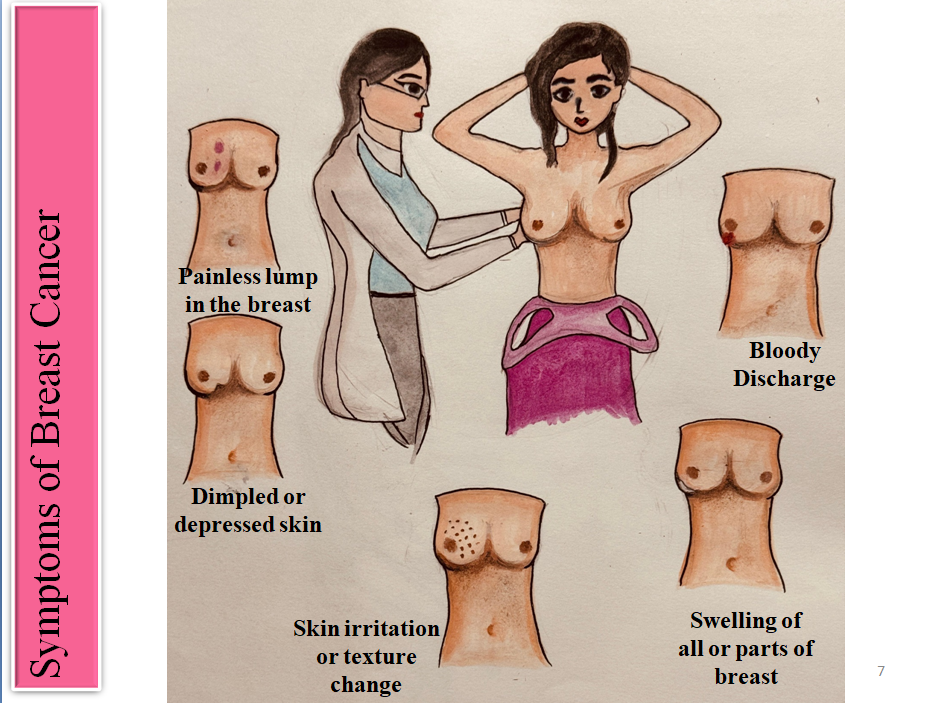
Symptoms of Breast Cancer
Protective factors of breast cancer
Protective factors for breast cancer include the following:
For all
Less exposure of breast tissue to estrogen made by the body. This can be a result of early pregnancy, Breastfeeding.
Getting enough exercise and maintaining healthy weight.
For high risk person
Having any of the following procedures:
Mastectomy to reduce the risk of cancer.
Oophorectomy to reduce the risk of cancer.
Ovarian ablation
Taking any of the following medine:
Estrogen-only hormone therapy after a hysterectomy.
Selective estrogen receptor modulators (SERMs).
Aromatase inhibitors.
Screening and Diagnostic Test
Health history
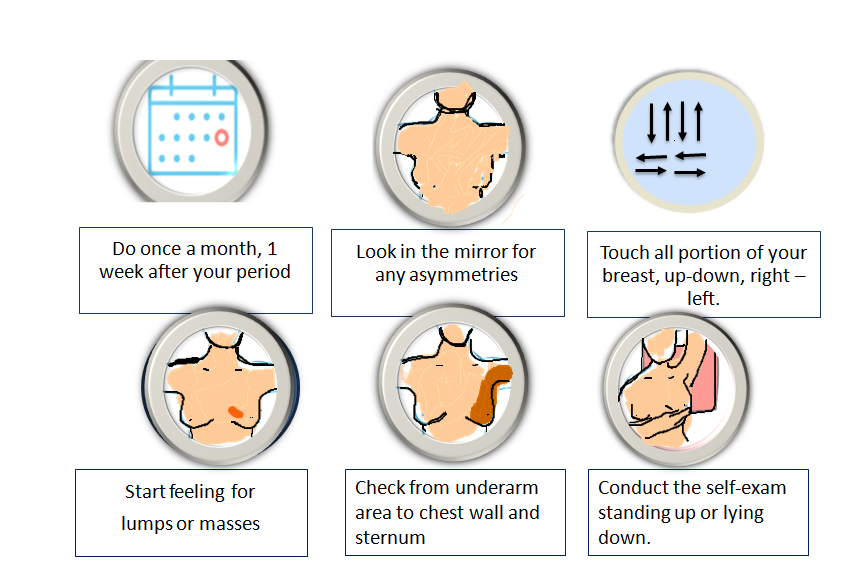
Self examination of Breast
Clinical breast exam (CBE)
Mammogram
Ultrasound exam
MRI (magnetic resonance imaging)
Biopsy
ØExcisional biopsy
ØIncisional biopsy
ØCore biopsy
ØFine-needle aspiration (FNA) biopsy
How to do a Breast Self examination in 6 steps
Tests and procedures used in the staging process
Sentinel lymph node biopsy
Chest x-ray
CT scan (Computed Tomography scan)
Bone scan
PET scan (positron emission tomography scan)
Estrogen and progesterone receptor test
Human epidermal growth factor type 2 receptor (HER2/neu) test
Multigene tests
Treatment modalities
Six types of standard treatment are used:
Surgery
Chemotherapy
Radiation therapy
Hormonal therapy
Targeted therapy
Immunotherapy
Factors affect prognosis
The stage of the cancer
The type of breast cancer
Estrogen receptor and progesterone receptor levels in the tumor tissue
Human epidermal growth factor type 2 receptor (HER2/neu) levels in the tumor tissue
Whether the tumor tissue is triple negative
How fast the tumor is growing?
How likely the tumor is to recur?
A woman’s age, general health, and menopausal status
Whether the cancer has just been diagnosed or has recurred
Your doctor will help you to understand your condition.